Email : info@climatechangeat.com
CLIMATE CHANGE
ALTERNATIVE THEORY
SOLVING GREATEST PUZZLES BY JOSEPH OTIENO ORUOCH
Climate change alternative theory endeavours to provide logical explanations for climate change and other natural occurrences that are not adequately understood. Such explanations must be based on scientific facts and must account for facts of experience clearly without the need to hide facts and or/falsify figures. Such explanations must provide satisfactory answers as to why certain natural occurrences happen and illustrate clearly how they happen. This information is important if we are to develop appropriate adaptive and mitigatory measures to natural occurrences most of which are disastrous.
Climate change alternative theory takes the perspective that planet earth operates in a simple mechanical manner with varying consequences some of which can be and have been devastating to life. A broad and comprehensive perspective is advanced based on the two heat sources relationship between planet earth and the sun. Explanations are also being provided for specific natural occurrences to ensure clear and consistent understanding of reality for purposes of developing relevant and appropriate responses.
The contention here is that responses are based on perception of causes of phenomena and misconceptions would only result in irrelevant mitigatory measures.
Incorrect understanding of causes of climate change would result in irrelevant policy measures and actions like planting trees or seeking to reduce greenhouse gases as means of controlling climate change without success. Another tragedy is that of paying a lot of attention to space while ignoring the fact of great amounts of heat inside the planet which is responsible for many of the challenges on the surface.
What causes climate change?
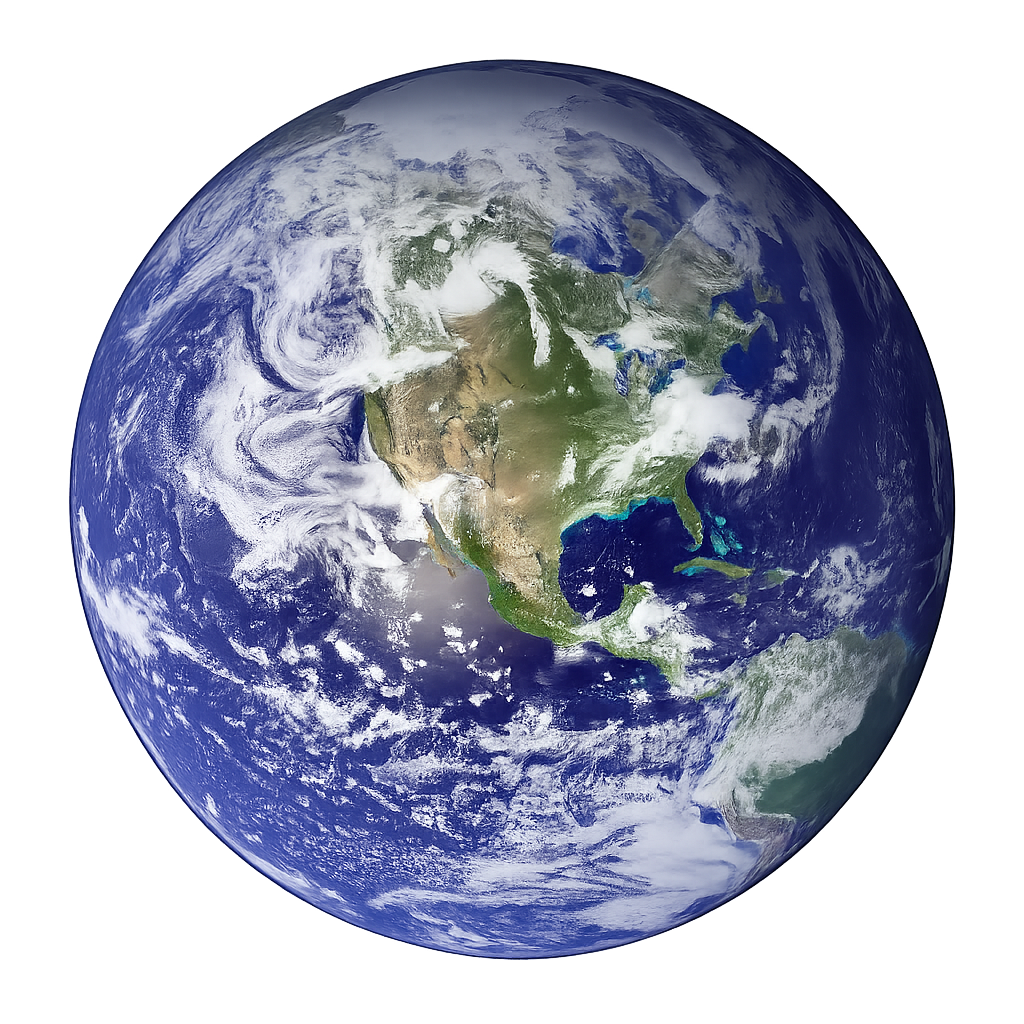
Climate change is caused by variation in the amount of heat diffusing through the crust on to the earth’s surface. A significant amount of heat is generated and accumulated inside the globe. Such heat varies from time to time and from one place to another. More heat onto the surface causes global warming while reduced heat allows global cooling. High altitude zones experience less intense heating and are much cooler while low altitude zones experience intense heating and are generally warmer.
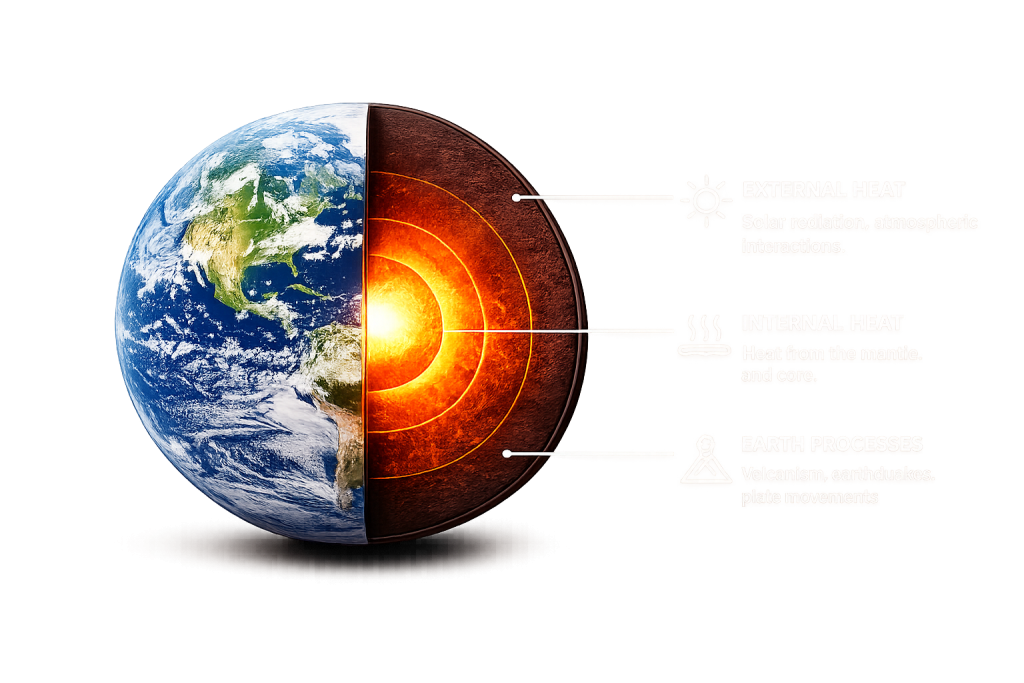
The planet has three main layers namely crust, mantle and core with crust being the outermost and core being the innermost. The crust acts as a cover for the inner contents but when subjected to more pressure than it can hold, it gives in through volcanic eruptions or by cracking and splitting open to create continents and oceans and/or seas. In the process substantial amounts of heat and pressure are discharged into the atmosphere. When the planet discharges its heat rapidly into the open atmosphere through eruptions, such heat is easily lost in open space resulting in global cooling.
CORE CONCEPT
The Earth- A Dynamic Thermal System
Earth is a complex system driven by energy. While solar influences our climate, internal heat from within the earth plays a fundamental role in shaping geological activity and long-term climate patterns.
Key Points To Consider
Sun Stability
Sun's direct heating effect on earth is negligible, is not responsible for climate change and doesn't fluctuate
Ice Cycles
Earth has experienced ice ages and temperate conditions meaning climate change is a natural process.
Volcano Cooling
Only volcanic eruptions have been observed to cause global cooling. It has not been demonstrated or observed that reducing greenhouse gases in the atmosphere can result in global cooling.
Pollution Divide
Climate change and environmental pollution of any kind are distinct and completely unrelated. Air pollution, water pollution and soil pollution do not have anything to do with climate change.
Human Impact
Humans and human activities have not caused climate change though humans have caused environmental pollution.
Altitude Zones
High altitude zones like highlands and mountain tops experience less intense heating while low altitude zones experience more intense heating as is the case with hot deserts
Earth Heat
Temperatures deep inside earth far from any human reach or influence do fluctuate over time.
The origin of greenhouse gases confusion
Greenhouse gases (Ghgs) are discharged from inner earth under pressure into the atmosphere. Inside the planet is extremely hot and so are its contents such as lava. In open environments the Ghgs are quickly and easily diluted and cooled down by atmospheric air. In an enclosure like a green house, the rate and process of dilution of emitted gases is slow. Because the gases are emitted warm or hot, they contribute to rapid warming of the surrounding air.
Myths and misconceptions
Climate change is caused by humans
The argument that climate change is caused by humans is not factual. Climate change has characterised earth’s existence long before humans came into existence. Planet earth has existed for at least 5.8 billion years according to the oldest rock ever measured. Our planet has experienced several ice ages including both major and minor ones.
The movement from one ice age through temperate conditions to the next ice age is a complete climate change cycle. Increased momentum of global warming only implies the process is approaching its peak or turning point and not necessarily an external factor unless demonstrated.
Global warming is caused by greenhouse gases especially carbon dioxide (CO2) and methane (CH4).
That Ghgs are responsible for climate change in general and global warming in particular is probably the most popular myth about climate change. The technology for predicting possibility of volcanic eruptions is premised on measurements of CO2 emissions around volcanic mountains with higher emissions indicating greater possibility and vice versa. This indicates CO2 is a symptom not a cause.
The argument that Ghgs contribute to global warming by trapping sun’s heat is to suggest that gases can act like valves allowing heat to move in one direction and not another. This is a serious allegation that needs to be demonstrated by explaining how their molecular structures allow this to happen. Mere statistical measurements of rising temperatures amid increasing Ghgs quantity in the atmosphere do not establish causal effect relationship.
Vegetation determines climatic patterns.
The argument that trees bring rain is a case of thinking in parody. It is the climatic condition of a region which determines its vegetation cover and not the other way around. No hot desert has been rehabilitated to cooler climate by means of planting trees.
Climate change is a linear process which is global warming ad infinitum.
Climate change is presented as a linear process of global warming which will keep rising ad infinitum yet historical evidence indicate strongly that climate change is a circular process moving from ice ages to temperate conditions repeatedly. Global warming is also presented as the greatest danger of climate change yet the most devastating aspect is an ice age.
Rainfall/Snowfall Drivers
Rainfall is the most critical aspect of precipitation even though snowfall is another aspect. Rainfall supports life by supplying vegetation with water and providing water for drinking and other uses while its absence implies droughts and famine. Rainfall and snowfall drivers are those factors which determine or affect possibility of rain or snow falling in any region over time. These factors can be classified as either primary of secondary. Primary factors are those that directly determine precipitation while secondary factors affect the primary factors. Primary factors are two while secondary factors are at least five.
The Primary factors are:
- 1) Presence of water vapour in the atmosphere.
- 2) Conducive atmospheric temperatures favourable for condensation of vapour into rainfall or snowfall.
Secondary factors are:
- 1) The Sun and Latitudes
- 2) Altitude
- 3) Volcanic eruptions/activities
- 4) Wind
- 5) Seas and oceans