
Climate Change: An Alternative Theory
By Joseph Otieno Oruoch
1. Introduction
Planet earth has experienced several glacial epochs or ice ages (Encyclopedia Americana 1978, 698), some major and others minor (Chambers’s Encyclopedia 1973, 357). What would happen to life on earth if a major ice age were to occur? What caused ice ages and have the responsible forces ceased operating? Is there anything we can do about natural climate change and what could that be?
This work began as an effort to establish why sustainable development remains elusive for Africa. Looking at the history of development in Europe from the Dark Ages through the Enlightenment to the Industrial Revolution brought the realization that some profound discovery was necessary to shake or even uproot the foundations of some belief system for meaningful development to occur. Enlightenment was occasioned by the Heliocentric theory which put the sun at the centre of the solar system in contrast to the anthropocentric views which put humans at the centre of all existence.
A deliberate attempt to establish how life began as a way of triggering another enlightenment led to the isolation of ice ages, earthquakes, volcanic eruptions and the theory of evolution for in depth analysis. The ensuing research revealed some relationship between the topics which appeared to provide an answer. One realization was that an ice age is the most devastating aspect of climate change. UNEP noted that “we urgently need a definitive agreement that will slow down climate change and help the most vulnerable countries and sectors to adapt to inevitable changes.” (UNEP 2009, 30) An agreement on a course of action can only be useful if it is based on solid science which can demonstrate that the steps taken have the potential for achieving global cooling.
Planet earth is billions of years old “and the geologic events of a single year, decade, or even century are not representative of the “present” in terms of geologic time. (Lowman J., 1997) In this discourse we will therefore look at observations recorded in historical books, recent media reports, and established scientific principles to put up an explanation for climate change that is based on facts and makes scientific logic. We will start by looking at certain observations.
2. Observations
Observation 1: Mount Blanc research finding
In June 2019, international television channel France 24 repeatedly aired through one of its features ‘France in Focus’, research findings on snow decline on Mount Blanc. It reported that using instruments which were immersed 10 metres below the surface of the mountain, researchers established that heat from the inner earth had increased by 1.45°C over a period of 12 years and this contributed to the mountain’s rapid snow meltdown. This is evidence that heat from inside the planet is impacting on the surface and the heat is increasing.
Observation 2: Solar activity and global warming
Many studies carried out in the recent past to establish whether there has been any change in solar activity to which climate change can be attributed have revealed two findings; one is that the impact of solar energy on world’s climate is negligible and two is that “Sun’s energy output has not changed over the past 30 years and recent warming observed on Earth cannot be attributed to changes in Sun activity.” (The Sun and Climate) There has been some argument that greenhouse gases trap solar energy thereby causing global warming. But such an argument is not scientific since no scientific explanation or evidence has been provided to prove that some gases have molecular structures which cause them to act like valves by allowing heat to move in one direction and not the other.
Observation 3: Lapse rate
This is the common principle that ‘the higher you go the cooler it becomes’ and vice versa. Digging down the crust reveals that temperatures increase as one goes down with research in one place indicating an increase of 20°C per kilometre (Ramsey et all, 1978, 28) and another an increase of 30°C per kilometre (Francis 1978). As is the case with all sources of heat, it is clear that lapse rate is another case of higher temperatures closer to fire and cooler temperatures away from it. Variations in rates of temperature changes can also be attributed to varying thickness of the crust otherwise manifested in altitudes.
Observation 4: Altitudes and climates
Global climatic patterns are determined by latitudes which is why it is generally colder towards the poles but warmer towards the tropics and Equator. But along the same latitudes, say the tropics or even the Equator, we still find that places with higher altitudes i.e. the highlands, experience cooler temperatures while those with lower altitudes experience warmer temperatures. Coastal areas which lie just above the sea level are generally warmer. Hot deserts also happen to be places with very low altitudes even though high mountains rising above such deserts experience cooler climatic conditions and Atlas Mountains at the edge of the Sahara Desert is a classic example.
Observation 5 Earth’s Structure
The earth has three main layers namely; crust, mantle and the core. For academic purposes the layers are divided into Mohorovicic discontinuity and Gutenberg discontinuity for the outer part of the mantle and its inner part respectively. The core is also divided into outer and inner core. But our interest is not in the number of layers or their names but temperature trends. Temperatures at the inner core are estimated to range between 5000 and 6000°C. Outer core’s temperatures range between 4000 and 5000°C (360° Atlas For Secondary Schools, 10) “Mantle temperatures range from approximately 200°C at the upper boundary with the crust to approximately 4000°C at the core – mantle boundary.” Google. The crust constitutes just one per cent of the earth’s mass. It is evident from the foregoing that the planet holds a lot of heat within and that the intensity of the heat diminishes with increasing distance from the centre.
Observation 6: Wind and ocean currents
The occurrence of air movements (wind) and ocean currents is another pointer to heating from below. Warm air ascends while cold air descends and so is water (liquids). When water is heated from above, then only upper layer is warmed while bottom water remains cold since the warm water at the top is lighter. In such an arrangement there are no currents and water at the bottom remains calm even when the top is boiling. This concept also applies to air. If it was only the sun heating air from above then upper atmospheric air would remain warmer than lower atmospheric air and there would be no turbulence or wind for that matter. Similarly ocean currents would not occur as warm water would remain at the top while cold water remains below. It is only heating from below that would occasion movements.
Observation 7 Contents of inner earth
Some understanding of the contents of inner earth may be necessary at this point. One interesting observation is by World Resources 1990-91 which recorded that “analysis of gas bubbles trapped in ice deposited over the past 160,000 years reveals that a warming of the global climate and a rise in CO2 and CH4 coincide. Conversely, lower atmospheric CO2 and CH4 levels coincide with global cooling.” (Hammond et al 1990, 19) May be a question one would ask is whether greenhouse gases are just symptoms of climate change and not its causes.
The United States Geological Survey did some study on contents of volcanic eruptions and noted that “The concentrations of different volcanic gases can vary considerably from one volcano to the next. Water vapor is typically the most abundant volcanic gas, followed by carbon dioxide and sulphur dioxide.” (USGS 1997) This was only an analysis of volcanic gases but lava contains a mixture of every mineral substances that we have on the surface.
Observation 8: Simultaneous volcanic eruptions
Between December 2009 and January 2010, the world media focused its attention on a volcanic mountain in the Philippines which showed increased signs of eruption but cooled off after several weeks without violent eruption. During the same period volcanic eruption occurred in the Democratic Republic of the Congo (DRC). It was also reported that another volcano erupted in Colombia. These eruptions coincided with a period of extremely cold winter in the northern hemisphere creating conditions only comparable to those witnessed several decades earlier. The southern hemisphere experienced a very wet summer than was often the case with a lot of rainfall in the tropics and southern temperate zone.
Between January and February 2010, Japanese coast guards captured on camera what appeared to be a submarine volcanic eruption. There were other volcanic eruptions in Iceland between March and April 2010. In May there were simultaneous volcanic eruptions in Ecuador and Guatemala. In August same 2010, a volcano erupted in Indonesia followed by another eruption from a different mountain in the same country from November to early December. Another volcano also erupted in Ecuador in December 2010.
These recent simultaneous volcanic eruptions were not the first. An American geologist, P.R. Vogt “suggested that there are likely to have been episodes in the earth’s history of particularly intense volcanism all over the world, separated by quieter intervals, and he produced evidence to show that over geological history, the rates of volcanic discharge in the area of Iceland have followed broadly similar trends to those of Hawaii, on the other side of the planet” (Francis 1978, 266-7).
Observation 9: Global cooling and volcanic eruptions
Global cooling has been experienced after simultaneous volcanic eruptions and/or after single massive eruptions. In observation 8 above, cooler global temperatures were witnessed after a series of volcanic eruptions in the year 2010. Wikipedia also records that “Eruptions large enough to affect climate occur on average several times per century, and cause cooling for a period of a few years. The eruption of Mount Pinatubo in 1991, the second largest terrestrial eruption of the 20th century affected the climate substantially. Global temperatures decreased by about 0.5°C (0.9°F). The eruption of Mount Tambora in 1815 caused the Year without a Summer.”
In yet another instance, it is recorded that “while most of the world was reveling in the gloriously-hued sunsets that followed the Krakatoa eruption, astronomers at the Montpelier observatory in the south of France were recording a rather more sinister effect. The radiant energy from the sun reaching their recording instruments at ground level dropped by about 20 per cent when the pall of dust first arrived over Europe, and their readings remained about 10 per cent below normal for many months.” (Francis 1978, 263) So the only activity or happening which has been observed to result in global cooling is volcanic eruptions. If greenhouse gases are responsible for global warming and they are emitted in huge quantities during eruptions, how comes global cooling occurs after eruptions?
Observation: 10 Ice ages
Ice ages have punctuated the history of planet earth. “Three major glacial periods are known, separated from each other by long periods of geological time when the world appears to have had a more or less uniformly temperate climate.” (Chambers’s Encyclopedia 1973, 357). Oscillation of global temperatures between glacial periods and temperate climates implies existence of natural historical forces driving the process.
Observation 11: Extinction of species
Animal species have become extinct for unexplained reasons over time. As one writer observes, “over the course of geological history there have been a number of clearly-defined episodes of large-scale faunal extinctions, when numbers of animal species have suddenly, and for no apparent reason, died out. Much the best known example of this is the dinosaurs. These reptiles were the predominant group of land animals throughout the whole Mesozoic period from about 225 million years ago to sixty million years ago.” (Francis 1978, 267)
Ice ages have occurred in the past and animal species have become extinct. Why do we think history cannot repeat itself?
Observation 12 From Pangaea to many continents
After an assertion that initially appeared odd by Alfred Wegener that the planet’s continents were once together but moved apart over time, and after the discovery of mid-oceanic ridges which corroborated Wegener’s assertion, plus the fact that tectonic plates are constantly drifting apart, it is reasonable to suggest that more continents could still be formed. From observations 8 and 9, it can be inferred that the formation of such continent(s) would result in a major ice age because substantial amounts of heat may escape from the inner earth once it cracks open in addition to water which would rush in to fill the newly created basin(s) causing further cooling.
3. Alternative theory of climate change
More heat from the mantle onto earth’s surface through the crust causes global warming while less heat onto the surface causes global cooling.
The sun and our planet are too large to be put in a laboratory for concise studies. They have existed far longer than our species and recorded history is insufficient for purposes of understanding their total characteristics. Several observations have been recorded including those mentioned above but they need to be put into perspective if we are to derive correct and meaningful conclusions that contribute to scientific knowledge.
Through science we have established certain laws governing forces of nature. We require the guidance of logic to ensure we derive valid conclusions from the many observations we make. The earth is a source of heat like the sun except that its surface is cooler with much of its heat stored inside. Solar energy output has remained constant as we learnt from observation 2 but earth’s radiant energy fluctuates. From observation 1 we saw that temperatures inside the planet have been rising while in observations 8, 9 and 10 we also saw instances of a cooling planet. That a volcano can remain dormant for long periods then erupt suddenly before going calm also attests to the fact of varying temperature and pressure conditions inside the planet.
From observation 1 we also learnt of increasing heat from inside the earth. In observations 3, 4 and 5 we looked at the earth’s structure and saw how heat amounts are distributed through it depending on altitude and distance from the centre. Moving away from or closer to the centre and hotter part gives us the same experience we would observe with fire or hot objects. It is naive to assume that heat from inside the planet simply dissipates on reaching the surface when evidence indicates otherwise.
Observations 8 and 9 indicate that when the planet cracks open and pours out some of its hot contents, then global cooling occurs. The fact that planet earth is a source of heat and that its heat varies, that when its heat increases, global warming occurs and when its heat decreases, global cooling occurs, leads to the assertion of alternative theory of climate change.
Perhaps the next question to ask is, what generates heat inside the earth? To answer this question requires that we look at the contents of the inner earth, their chemical properties and physical conditions obtaining inside there. The general observation is that temperatures are very high and so are pressures. Earth’s outermost layer, the crust, is made up of hard rocks which insulate the inner contents while raising pressures. This is the reason it must accumulate sufficient pressure to generate enough force to cause earthquakes and eventual eruptions.
The molten part of the earth, the mantle, contains much the same substances as the crust which is a cooled layer. There are huge deposits of sulphur and water compounds inside the earth. Water and sulphur among others under high pressures and temperatures must have formed sulphuric acid and other acids. Since the molten rocks contain metallic substances like potassium, sodium and many more, constant chemical reactions would most likely occur because the mixture includes acids and metals. The greenhouse gases are the by-products of such reactions as chemical reactions often result in the discharge of gases and some research has established that some gases are found in higher quantities in wells and swamps just after earthquakes (Gaskell, T.F., 1970). Chemical reactions are exothermic and when they happen in an enclosure like the inner earth they create more pressure besides raising temperatures.
4. Two-heat Sources Model
With the realization that both the sun and the earth produce heat which affects global weather and climatic patterns comes the need to explain how the process takes place. This section endeavors to provide a satisfactory possible explanation based on principles of science especially thermodynamics. But we will start by outlining basic assumptions upon which the two-heat sources model is premised before introducing illustrations to clarify arguments and explanations.
1) Both the sun and the earth are producing heat that affect climate with the sun at the top and the earth at the bottom.
2) From observations 2, 3 & 4, we are inclined to assume that (a) the sun’s heat is constant and its heating range diminishes with increasing distance from it though there is a line of significant heating, (b) the earth’s heating range varies with changing altitudes and its significant heating range diminishes as we move away from it, and (c) the earth emits more heat where the crust is thinner and less heat where the crust is thicker.
3) There is a gap between the heating ranges of the two bodies but the height of the gap varies from one point to another depending on both altitudes and latitudes. The gap is longer towards the poles but shorter towards the Equator. This is the precipitation column or condensing chamber.
4) The sun determines seasonal changes on earth by how it heats or fails to heat upper atmospheric air thereby determining the volume of cold air falling over the surface. Greater volumes of cold air implies more cooling effect on the surface. The longer the precipitation column the cooler it is and vice versa.
We can now look at illustrations to help us digest this relationship further.
Figure 1 shows heating variations with changing latitudes. Since the earth’s surface is curved, the figure portrays a longer cold air column towards the left which is the tropics and shorter cold air column towards the right which is the Equator. The short column over Equator means more heating of the air above which ascends upwards. Long cold air column towards the poles implies more cold air falling over earth and since cold air is heavier, it pushes warm air over earth towards Equator where the air is even warmer and lighter. This establishes a pattern of air movement where wind blows from the poles over the surface towards Equator where it gets heated and ascends upwards. The rising air eventually looses its heat and falls back in a continuous cycle.
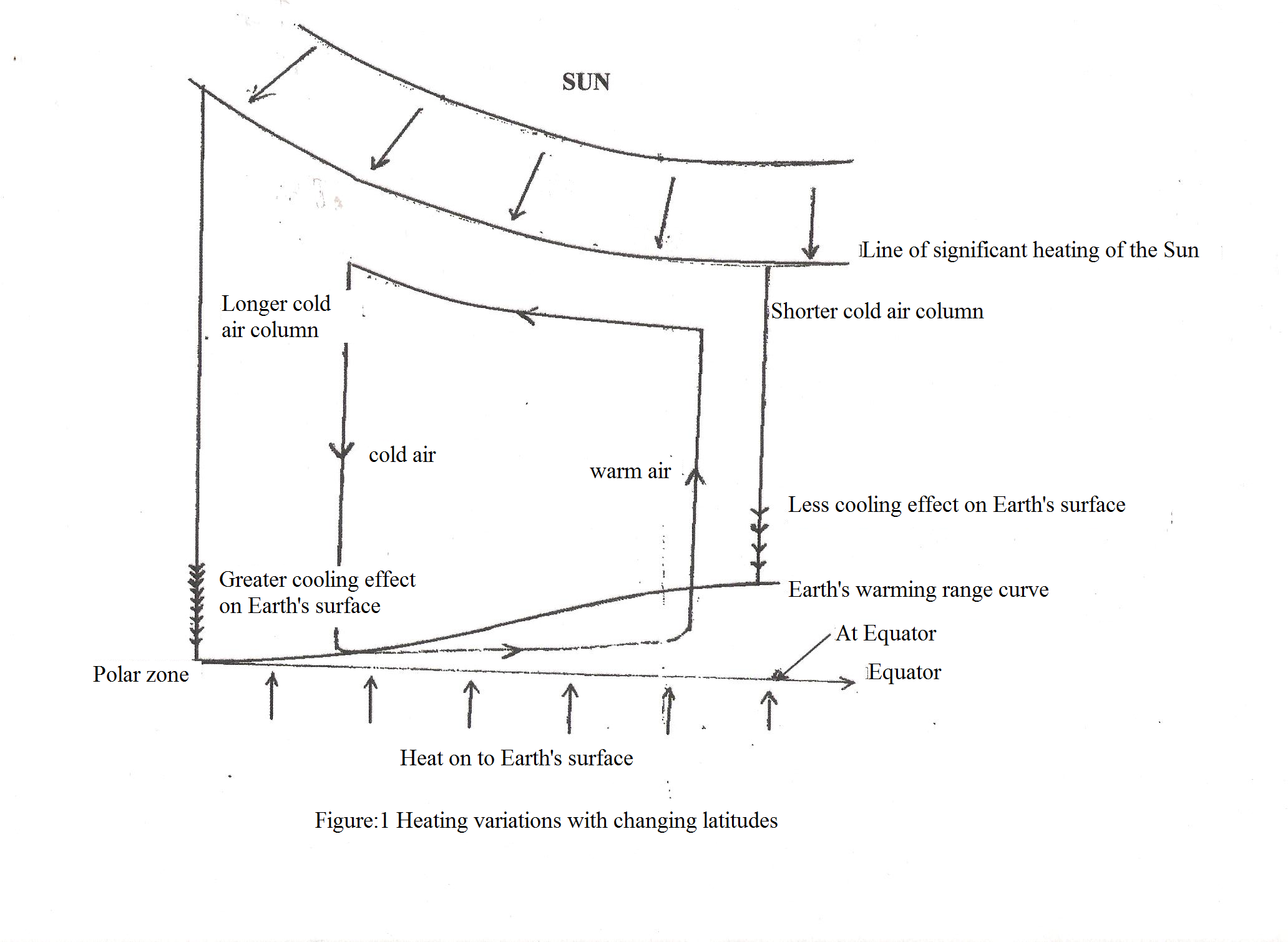
Figure 2 illustrates what happens when the sun is over the Equator. There is a balanced but relatively ‘shorter’ long cold air columns towards each tropic. Cold air falls over the tropics in a fairly balanced manner then move towards the Equator where the air rises. The understanding in this model is that when abundant cold air falls over earth, it suppresses its heating capacity which is then less manifest unlike when less cold air falls over earth when the latter’s warming capacity becomes more manifest.
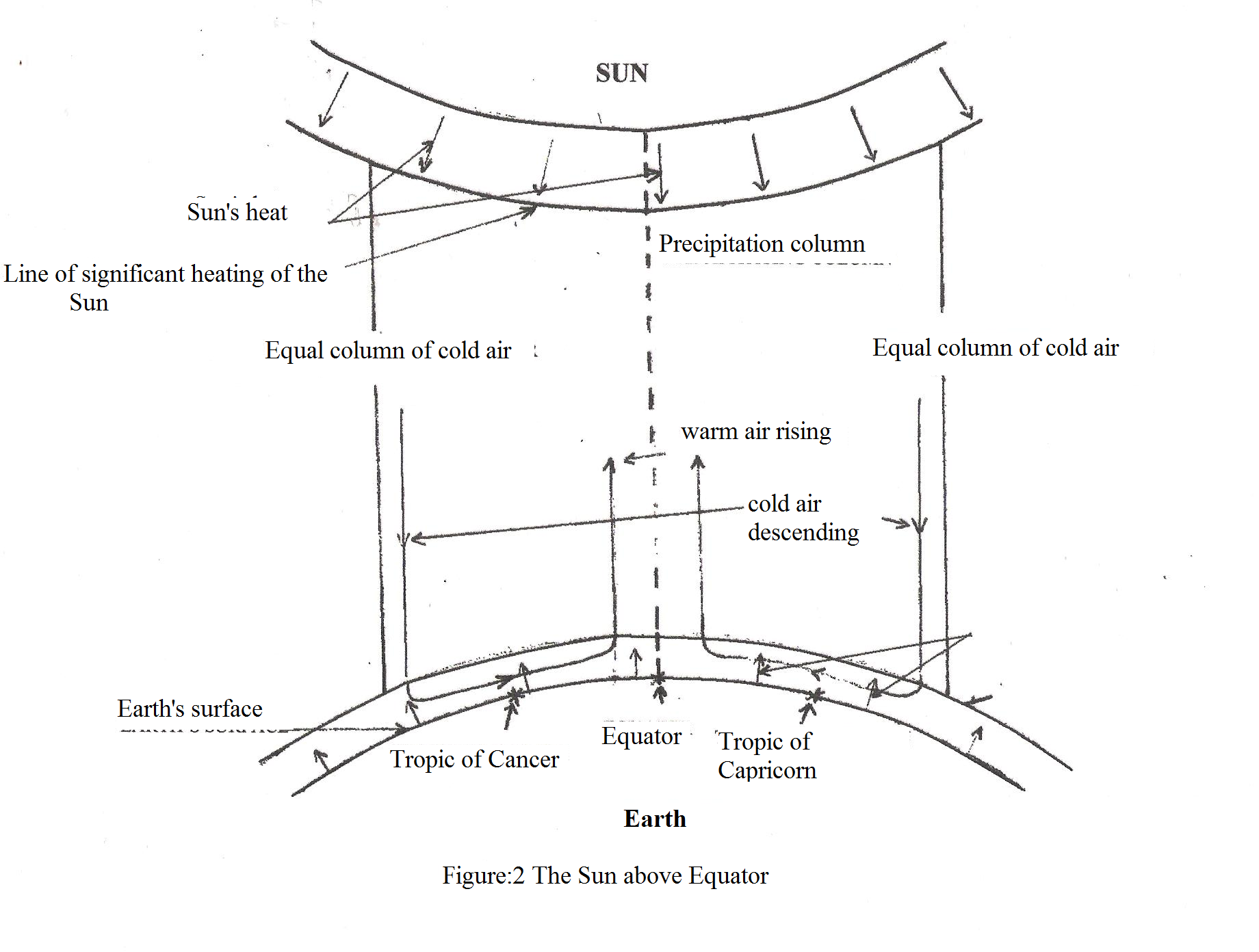
Figure 3 depicts the sun over the tropic of Capricorn which is winter in the north and summer in the south. The long cold air column is even longer over the tropic of Cancer meaning more cold air falling over the northern hemisphere which creates greater pressure as the cold winds rush southwards to displace the lighter air around Equator and tropic of Capricorn. The winds are thus stronger from north to Equator while winds from south to Equator are less strong due to shorter cold air column resulting in less cold wind falling over the surface.
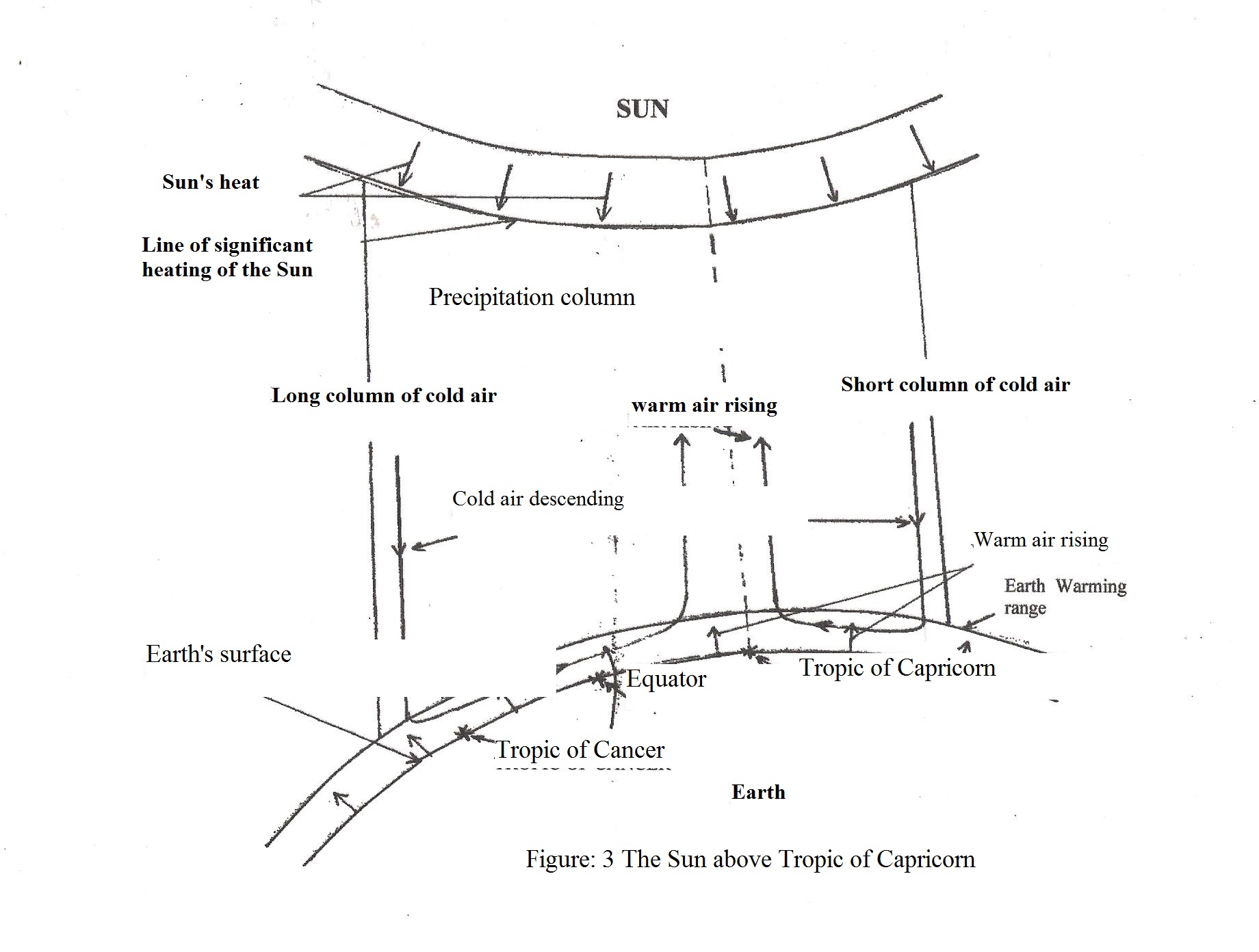
Figure 4 is just the opposite of figure 3 when the sun is over the tropic of Cancer resulting in summer in the north and winter in the south. Short cold air column over tropic of Cancer implies less cold air flowing from north to Equator but the longer column in the south implies more cold air falling over the surface thereby forcing its way northwards to displace lighter warm air around Equator and the tropic of Cancer.
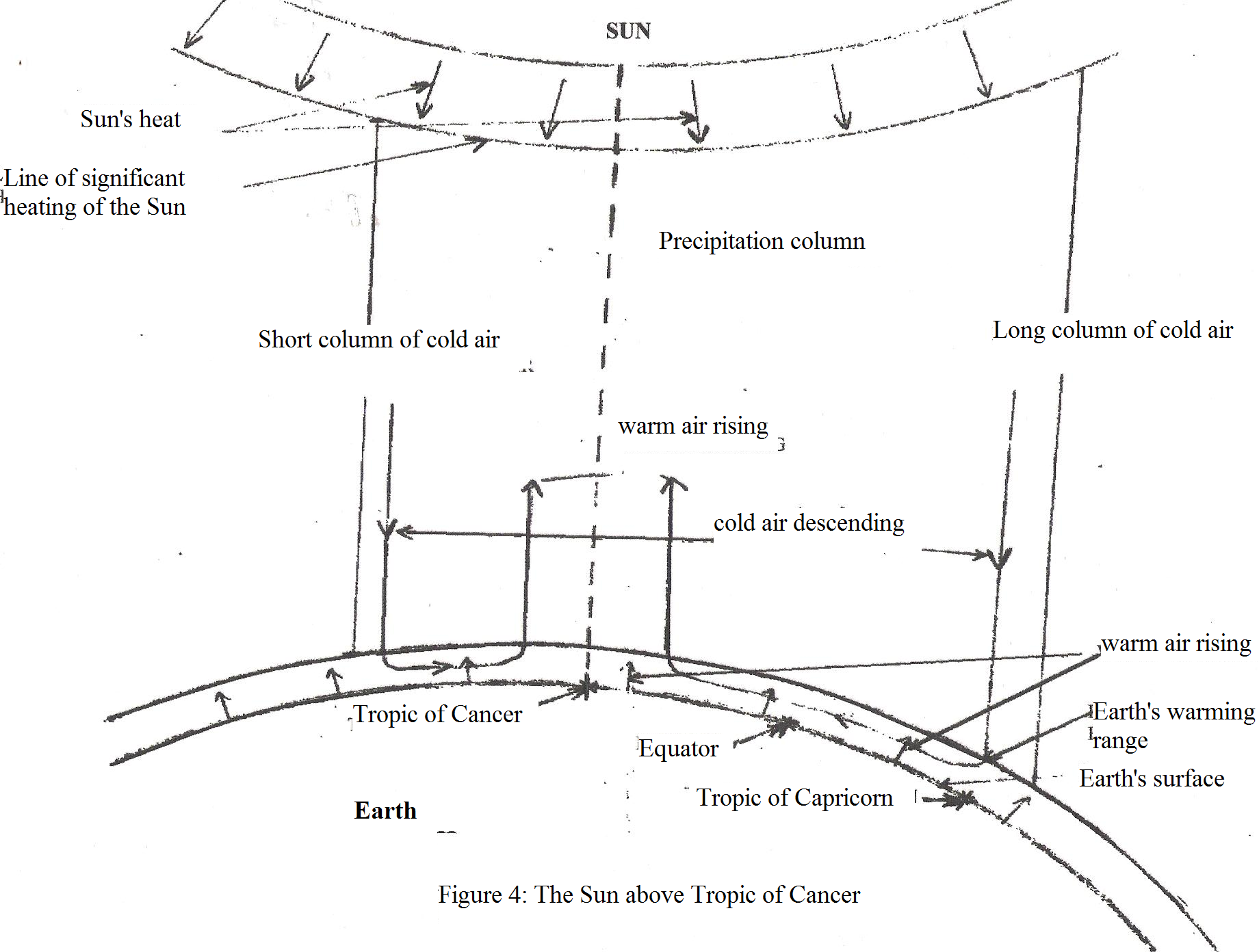
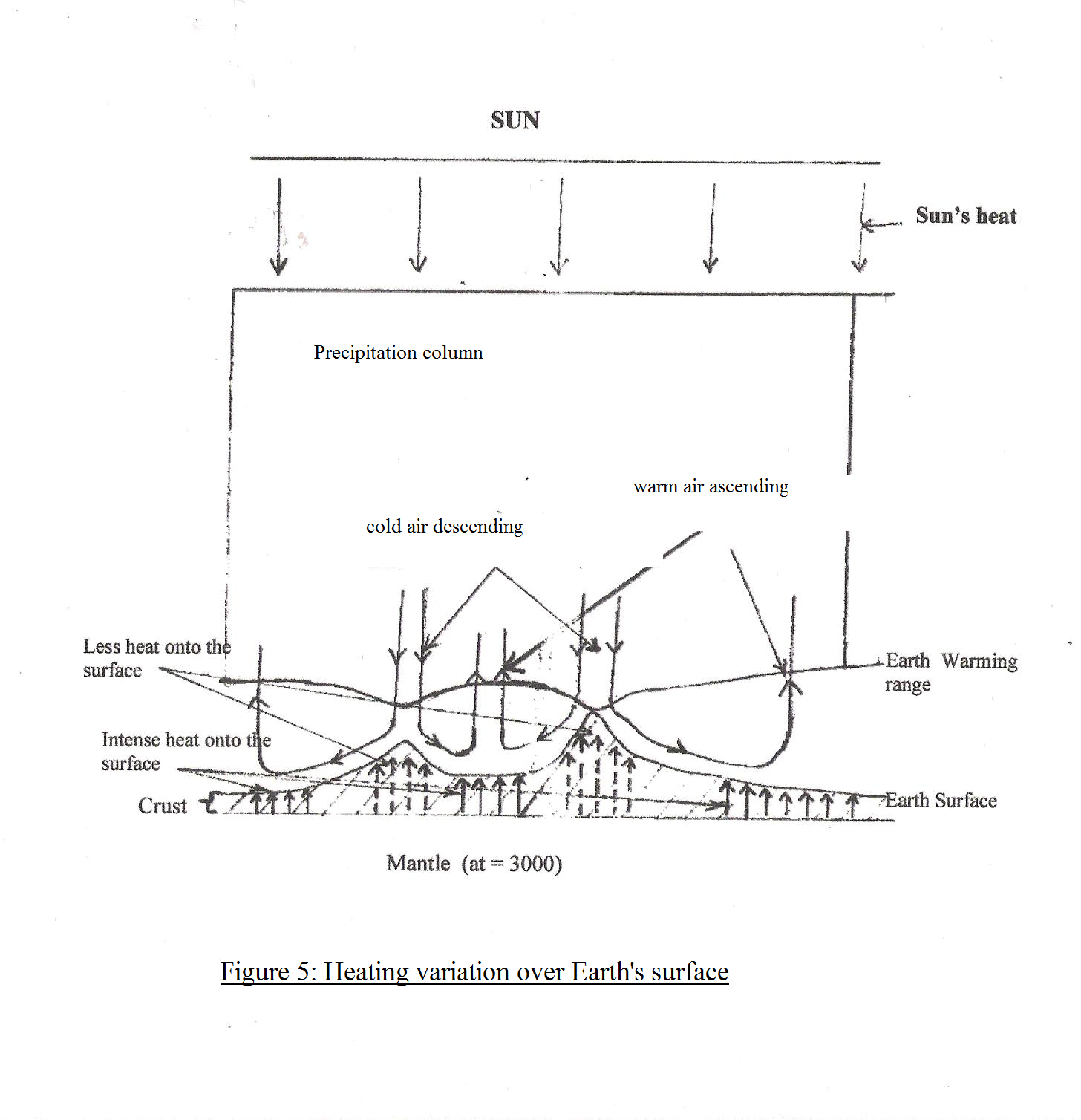
Figure 5 depicts heat exchanges and wind movement patterns along the same latitude with varying altitudes. Intense heating from points of low altitudes pushes the earth’s warming range upwards thereby reducing the height of the precipitation column. Less heating from points of high altitudes lowers the earth’s warming range thereby extending the condensing chamber downwards. This then results in a situation where there is more cold air falling over high altitude areas which then flows downwards as it moves to displace warm air over the low lying grounds.
Conclusion
Climate change is a natural historical process which results from activities inside the earth. Earth’s temperatures increase gradually causing global warming but when temperatures and pressures build to greater levels then eruptions occur. Through eruptions the planet looses some of its heat resulting in global cooling. Indeed the only process which has been observed to occasion global cooling is volcanic eruption.
Volcanoes may erupt simultaneously or in series and still cause global cooling. But there are other instances when single eruptions of one volcano have caused global cooling especially where and when the magnitude of such eruptions is so great. The implication of this phenomenon is that efforts aimed at mitigating global warming must focus on regulating the heat that is produced and stored inside the planet.
While global warming is a slow and gradual process, global cooling is an abrupt and sudden occurrence which can trigger an ice age. We also have to realize that an ice age is the most devastating aspect of climate change. Ice ages have occurred in the past and history is bound to repeat itself. We must therefore work to interrupt the natural cycle of climate change if we are to preserve our species on planet earth.
The sun has no role in climate change and we need to desist from attributing climate change to solar activity by whichever means. Greenhouse gases also have no role in global warming but may be its symptom since they occur concurrently. Disasters which occur on the planet’s surface, whether relating to climate change or earthquakes, are the consequences of natural processes within it. It therefore means that by regulating heat inside the planet we can mitigate global warming, earthquakes and occasionally accompanying tsunamis, drought, famine, heat waves and other natural calamities associated with climate change like storms and diseases. We can also avoid an ice age by ensuring heat and pressures inside the planet do not accumulate to a point of triggering major eruption(s) or splitting the continents.
Since the earth is a source of heat and the sun is also another, we must adopt a two-heat sources relationship model between the two. It also appears that we have been confusing earth’s radiant energy with solar energy. This is because solar energy has remained constant even when there is global cooling following major eruptions.
Lastly we have to start considering tapping into earth’s heat energy reserve however dangerous that may appear. This will provide humanity with sustainable source of energy while conserving our environment. In fact, it may only require extending geothermal power exploration to places like coastlines or such other places with low altitudes but are near substantial water bodies.
Recommendations
- There is need to establish a new science and set of technologies to facilitate a deeper understanding of the inner earth with the objective of establishing ideal conditions necessary for the avoidance of either global warming or an ice age.
- There is also the need to seek means and ways with which to harness the vast heat energy below the earth’s crust to provide for energy requirements on the surface in addition to mitigating global warming.
References
- 360 Atlas for Secondary Schools, 2nd end. Oxford University Press
- BBC –Science & Nature, Planet Earth 2006 (www.bbc.co.uk/../planetearth/) Accessed 1 August 2009
- Bennett, R. and Estall, R. ed. 1991: Global Change & Challenge Routledge, London & New York
- Bowen, A. and Pallister, J. 2001: A2 Geography. Heinemann Educational Publishers, Oxford
- Chambers’s Encyclopedia 1973 vol. 6 International Learning Systems Corp. Ltd., London
- Encyclopedia Americana 1978 vol. 14 Americana Corporation, Connecticut
- France 24, French in Focus – Mount Blanc meltdown aired June 2019.
- Francis, P. 1978: Volcanoes. Penguin Books Ltd., England
- Gaskell, T.F. 1970: Physics of the Earth. Thames and Hudson, London
- Hammond, A.L. et al ed. 1990: World Resources 1990-91. Oxford University Press, New York
- Hidore, J.J. and Roberts, M.C. 1990: Physical Geography: A Laboratory Manual. Prentice Hall Inc., New Jersey
- IPCC 2007: Climate Change; Impacts, Adaptation and Vulnerability, Fourth Assessment Report. (http://www.epa.gov/climatechange/) Accessed 5 August 2009.
- Israeli Ministry of Foreign Affairs 1999: Combating Desertification – The Israeli Experience.
(http://www.mfa.gov.il/MFA/Mashav+-+International) Accessed 30 October 2009
- Lowman, P.D. Jr. 1997: Global Tectonic and Volcanic activity of the last one million years.
(http://www.denali.gsfc.nasa.gov/../lowman.html) Accessed 14 October 2009.
- Ramsey, W.L. et al 1978: Holt Earth Science. Holt, Rinehart and Winton Publishers, New York
- Shillington, K. 1989: History of Africa. Macmillan Education Ltd. ,London
- The Sun and climate, (https://worldmetday.wmo.into) accessed 24 December, 2019
- UNEP 2009: UNEP and Partners: United to Combat Climate Change (www.unep.org/climatechange/) Accessed 1 August 2009
- UN-Habitat 1996: Issues in the Integrated Planning and Management of River/Lake Basins and Coastal Areas: A human settlement Perspective. Nairobi
- USGS 1997: Desertification (http://pubs.usgs.gov/..desertification.html) Accessed 30 October 2009.
- USGS 2004: Science for a changing world (http://pub.usgs.gov/fs/2004/3062/pdf) Accessed 1 August 2009
- VietFun For All 2009: Drying Rivers, Lakes and Reservoirs (http://www.suprememastertv.com/bbs/b…to) Accessed 30 October 2009
- Wikipedia 2010: Climate Change (en.wikipedia.org/wiki/Climatechange) Accessed 24 April 2010.
- WWF 2007: Drying Rivers (http://www.chinatownconnection.com/drying) Accessed 14 October 2009.